Wednesday, April 3, 2024

"Roll Away the Stone"


Another true tale of la vie de la bohème by Dan Leo

Illustrations and additional dialogue by rhoda penmarq, exclusively for quinnmartinmarq™ international productions

This episode brought to you by Husky Boy™ cigarettes

"The first thing I do before writing my daily 10,000 words is to fire up a Husky Boy!" – Horace P. Sternwall, author of the heart-warming new memoir A Child's Easter on the Bowery

for previous story, click here

to begin series, click here


"Yo! Idiot! Wake the fuck up!"

Smiling Jack awakened to that little fellow they called "Bowery Bert" slapping his cheeks.

"Oh, hello, Bert," said Jack.

"What the fuck are you doing, freezing yourself to death in the freezing snow leaned up against a light pole? What're you, a fucking moron?"

The shabby little man in the ancient cloth cap looked up at him through the thick swirling snow, the stub of a cigar smoking in his lips.


"I must have fallen asleep," said Smiling Jack.

"Bullshit," said Bowery Bert.

"Heh heh, no, really," said Jack. "I was just standing here, looking for lost souls to give my book to –" he glanced down at the little book in his right hand, his frozen right hand –"and I guess I just, uh, got sleepy, and –"

"Listen, jackass," said Bert, and he pointed his bare finger sticking out of his ragged canvas glove, "don't give me that malarkey.


You deliberately stood out here in this blizzard in a concerted and conscious effort to top yourself."

"Um, uh –"

"Did you think for one little moment that, in the words of my good friend Will Shakespeare, alias the Bawdy Bard,'the Everlasting had not fix'd/His canon 'gainst self-slaughter'?" 

"Did you say Shakespeare?"

"Yeah, you ever hear of him?"


"Well, of course I've heard of him, heh heh –"

"Author of Hamlet? You know that play?"

"Um, uh –"

"What about King Lear? Macbeth? Othello? Romeo and Juliet?"

"I've heard of Romeo and Juliet –"

"Oh, you've heard of it."

"Yes, I think so –"

"So what you're telling me in other words is you've never read a word of Shakespeare or seen a single performance of one of his immortal plays."


"Well, um, heh heh, you see, I'm more of a movie fan myself. You know, Laurel & Hardy, Wheeler & Woolsey, Joe E. Brown, I used to like W.C. Fields, but then when I got sober, I, uh –"

"In other words you're an idiot. And yet you want people to read your stupid book."

"Well, my book is meant to help people, Bert. To help them realize that they have a drinking problem, but that by accepting their powerlessness over alcohol –"


"Bollocks. It's books like yours that make people want to get drunk, and who can blame them? Gimme that."

Bert grabbed the little book out of Jack's snow-covered hand. He slapped the book to get the snow off of it, then opened it up.

"Right, now I'm just gonna read the first words I see at random. Okay, I quote:

because there is indeed a Higher Power, my friend! Some call him God, or Jehovah, some call him the Buddha. But me, I call him the Big Guy.


And this Big Guy wants to be your pal. So all's you got to do is get down on your knees, and fold your trembling sweaty hands together, and say, "Hey, Big Guy, Big Fella, help me out here, pal, 'cause I'm tired of waking up every morning like I been run over by a dump truck, with a taste in my mouth like a mouse crawled in there and died, tired of hating myself, tired of hating life, tired of everybody I know avoiding me like the Black Plague, sick and tired of being sick and tired every second of every rotten day and nightmarish night…"


"Jesus Christ, man," said Bowery Bert.

"I thought that passage was pretty good," said Smiling Jack.

"Oh my fucking God," said Bert.

"You didn't like it?"

"Here," said Bert. "Take it back."

"Oh, please keep it, friend," said Smiling Jack. "Perhaps someday you will find it helpful –"


"You implying I got a drinking problem?"

"Well, no –

"Then what the hell are you implying?"

"Well, I suppose I just assumed –"

"Assumed I was an alcy because I'm out on the Bowery at midnight in a raging blizzard, and because I ain't dressed in a Brooks Brothers tweed suit and camel's hair polo coat with a Bollman's fedora on my noggin?"

"Oh, no, heh heh –"


"On accounta my fingers stick outa my gloves, and because my old cap looks like it's a hunnert years old, which it is?"

"No, not at all –"

"Well, let me tell ya, pal, I may look like a Bowery bum but I ain't a Bowery bum."

"You ain't? I mean, you aren't?"

"No, I ain't. I am an angel."

"A what?"

"You heard me. I'm an angel."


"No kidding? Because it's a strange thing, but I always thought you had an unusual quality about you."

"Yeah, that's on accounta I'm an angel, more specifically, a guardian angel, but in the guise of a Bowery bum."

"So you're my guardian angel?"

"Well, that ain't the way it works, pal. You see, there's only so many of us guardian angels around – to be exact, twelve thousand nine hunnert and twenty-two of us. And between us we got to cover the whole goddam world. So what we do is we each get a district. Me, for my sins, which I won't go into right now, I got this neighborhood."


"So that's why they call you –"

"Bowery Bert. Yes. This whole slum around here is my territory, and let me tell ya, it ain't easy, pal."

"I can imagine."

"Worst district in the world, but I got stuck with it, so what're you gonna do? Nobody wants to hear a guardian angel complain. Oh, no. We get to hear everybody else's problems, but nobody wants to hear our problems."

"Well, Bert, if you ever need an ear to be lent–"


"This ain't about me. This is about you, my friend, deliberately freezing yourself to death."

"But I'm not dead."

"Oh, ain't you? Try to move."

Smiling Jack tried to raise his arm, the arm from which extended the hand that had held his book, but he was unable to budge it. And he realized with horror that he was indeed frozen stiff.

"I'm frozen," he said.


"So you finally got the newsflash."

"But how can I talk if I'm frozen?"

"You ain't talking. You're communicating what they call telepathically."

"Oh my God. You mean I'm really dead?"

"That's what you wanted, wasn't it?"

"Well, I, I suppose I did succumb to a kind of feeling of despair, but I didn't know I would really go through with it –"

"That's no excuse."


"So I'm going to hell?"

"What do you mean, going to?"

"You mean I am in hell?"

"I mean you been in hell your whole goddam life, except for maybe when you were a kid on your birthday or Christmas or Easter, chowing down on all them chocolate eggs and bunnies. But, lookit, every once in a while we guardian angels get to help somebody out. Not often, but sometimes, and only oncet in any human's lifetime. So, if you want, I can maybe give you a break. All's you got to do is choose life over death."

"Gee."

"What's your choice?"

"So I can choose either to be dead or be alive?"

"Like I said, your choice, but I ain't got all night, and you ain't got all night. About fifteen more seconds and it's gonna be too late, and it's off to the next world for ya."

"And what is the next world like?"

"That I am not at liberty to tell ya, pal. House rules. Ten seconds you got."


"Ten seconds?"

"Now it's nine. What's your choice? Life, or what my other good friend Søren Kierkegaard called 'the great unknown'?"

"Um, gee –"

"Four seconds."

"Four?"

"Now it's three."

"Um, uh –"


"Two seconds. One –"

"Okay! Yes, I choose life!"

"Solid, Ted, 'nuff said."

And suddenly and all at once Smiling Jack felt life coursing through his body and his sluggish blood flowing through his veins.

He was cold, and shivering, but alive.

"How's it feel, buddy?" said Bowery Bert.

"It feels, uh –"


"Better than bein' croaked?"

"Yes," said Smiling Jack.

"'Cause let me tell ya something. You got all of eternity to be dead, but only just this one lifetime to be alive."

"Yes, I, um –"

"What you should do, you want my advice, what you should do now is you should go over to Ma's Diner and warm up with a good cup of joe. Maybe get some corned beef hash and eggs. Maybe a couple of them hot cross buns Ma makes, with plenty of butter on them."


"Yes. I guess you're right. A nice hot cup of coffee does sound good –"

"And then after you eat I want you to light up a smoke and look out that plate glass winda there at the falling snow, and just kind of appreciate being warm and alive."

"Yes, I should do that."

"'Cause, remember, life is short, but death is forever."

"Thank you, yes, I'll remember that, Bert, thank you."


And then Bowery Bert was gone, and where he had stood was only the heavy falling blustering snow.

Jack noticed that Bert had kept the book, his book, the book in which he had collected all of his hard-earned wisdom. He hoped Bert wouldn't just throw it away.

Smiling Jack trudged through the falling snow and the snow that covered the ground a foot high across the street to Ma's Diner. After he had sat at the counter and placed his order with Ma, a mysterious moment of panic urged him to check his pockets, and he quickly realized that his wallet was empty of money, and his pockets were empty of coins.

He had also somehow lost his cigarettes, and his Zippo lighter.

He called Ma over to cancel his order, explaining that he was unexplainably broke, and had even somehow lost his cigarettes and lighter, but Ma took pity on him, and told him he could have his coffee and a meal on the cuff, and she also let him have a quarter for the cigarette machine. 

Little did Smiling Jack know that Ma was also a guardian angel, just not officially so, and her place was assured in the hereafter, among all the other saints and angels for all eternity.


Wednesday, March 27, 2024

"Requiem for a Snowman"


Another true tale of la vie de la bohème by Dan Leo

Illustrations and additional dialogue by rhoda penmarq, exclusively for quinnmartinmarq™ productions

This episode brought to you by Husky Boy™ cigarettes

"Try the new improved Husky Boy patented 'charcoal-infused' Cork Tip, for all that 'husky' flavor but with 99% fewer irritating tars and resins!" – Horace P. Sternwall, author of the searing new masterpiece Hobo Jungle: a Novel of Today's "Forgotten Men" 

for previous story, click here

to begin series, click here


Meanwhile, some dozen or so blocks easterly and at this very instant, Gerard "Gerry" Goldsmith (known to his friends as "the Brain") emerged from Bob's Bowery Bar into the heavy and blustering falling snow. The air was bitter and cold, and the fat flakes slapped wetly into his face, but Gerry felt no discomfort, having downed some dozen glasses of Bob's basement-brewed bock over the past few hours in the company of his fellow bibulous gentlemen of shabby leisure.


Gerry looked up, at the oceans of snow tumbling down from the sky between the buildings and the tracks of the elevated train line, the snow falling as if God himself were emptying out the clouds of the heavens upon the earth and transforming the surrounding slum into a quaint small town in a glass globe.

Fortunately for Gerry, he only had to walk down the block and around the corner to get home to Mr. and Mrs. Morgenstern's tenement apartment building and to his tiny "studio" on the sixth floor, a former storage room, but quite suitable for a philosopher like himself. As well, Gerry was convinced that the six flights of stairs he had to climb up and down several times a day added five or ten years to his lifespan, as how else would he ever take exercise, never having been one for healthful walks to anywhere farther than the nearest bar. And this was New York City, thank God, and there was always a bar at least a block away. 


Gerry plodded through the foot-high snow down the Bowery sidewalk, being especially careful not to fall, as who knew if he would be able to get get up again should he fall, when, suddenly, he saw the oddest sight up ahead in the pale glow of a street lamp.

A snowman.

A snowman built up against the pole of the corner light.

How extraordinary! 

Gerry forged closer, through the swirling thick snow. 


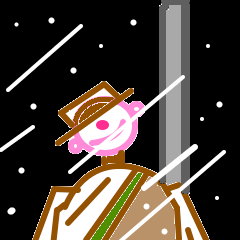
And there stood the snowman, amazingly realistic, he even had a snow-covered hat on his round little head. The body was short and fat, and the funny thing was that the round face of the snowman seemed somehow to be smiling.

Drunkenly Gerry extended an ungloved finger and touched the snowman's cheek.

His finger went through an inch of snow and then touched something that did not feel like snow. It felt like frozen meat, like one of those big cuts of beef rump that Gerry's late mother kept packed in dry ice in the basement box for a tasty Sunday roast. 


"Uh-oh," said Gerry, aloud, and quickly he began slapping at the head and shoulders and arms and torso of the snowman, and, yes, the snowman was none other than that fellow known as Smiling Jack, the reformed drunkard and zealot of sobriety, now frozen quite stiff. 

Gerry would say this for poor Jack, he still had a smile on his rubicund face, even in death. Across his chest was the strap of the leather satchel he kept his tracts in, and in fact his frozen right hand, in its worn and ragged woolen glove, still held a copy of his famous self-written little book.


Gerry pulled it loose and brushed it off, looked at the cover made of the cheapest paper stock, with the childish drawing of a drunk-looking man leaning against a lamp post and holding a bottle, and in large letters

         ARE YOU A DRUNKARD?

                        BY  

           “SMILING JACK”


How many times had Smiling Jack forced one of these pathetic booklets into Gerry's hands? Ten times? A dozen? And what had Gerry done with them? Used them for toilet paper, or to roll cigarettes with. He had tried to read a page now and then, but the prose was just too unbearably bad, no matter how noble the sentiments so clumsily expressed. Nonetheless you had to give Smiling Jack some credit, always earnestly and amiably trying to spread the good word despite his complete lack of literary talent.


But still, you would think that even a moron like Smiling Jack would have known better than to stand out here in a blizzard trying to hand out alcoholism pamphlets until he froze to death. At least he could have taken a break now and then and just popped across Bleecker street to Ma's Diner for a cup of coffee or hot cocoa. Didn't he have the nickel for a cup of joe or cocoa?

Curiously, almost as if he were a citizen policeman, Gerry went through Smiling Jack's pockets.


He found not only a pack of Lucky Strikes, minus only two cigarettes, and a working Zippo lighter, but also seventy cents in loose change, and a wallet with nine dollars in it. So Jack had had the means to go into Ma's Diner, but he had not the desire or the common sense to do so. How very odd. Was it suicide? Was it an act of penance gone accidentally too far? No one would ever know. And who would care? 

Gerry felt that he should care, and he did, in his way, and he imagined (or perhaps he actually heard) Smiling Jack's genial voice saying, "Hey, help yourself, pal, what was mine is now yours," and so, after only a moment's hesitation, Gerry put the seventy cents in coin in the pocket of his old tweed trousers, then took the nine dollars out of the wallet, and put the wallet back in Jack's pocket. He then extricated one of Jack's Lucky Strikes and rolled it between his palms to take the frost off of it, then he put it in his lips and, after a few tries, successfully lighted it up with Jack's Zippo.


An automobile came trundling slowly down the Bowery through the thick falling snow, and it passed and continued on its way.

"Well, here's to you, Smiling Jack,"
 said Gerry, silently. "I'll say this for you, you went out just the way you came in, with a smile on your face and your pamphlet in your hand, a pamphlet filled with the hard-earned wisdom of your soul, and offered to the tosspots of the Bowery one and all, for free, gratis, and for nothing. God love you, Jack, if there is a God, and surely if there is a God, he must love such a man as you. I thank you for the cigarettes, and for the Zippo, and for the nine dollars and seventy cents in U.S. currency. Sleep well, Smiling Jack, and may you keep smiling through all eternity."


Gerry shoved the little book back into Jack's frozen hand, and he pressed the fingers tight over it. 

"Ta for now, Smiling Jack," said Gerry, aloud. "I'll see you soon enough, my friend."

Gerry turned back, back toward Bob's Bowery Bar. His friends would all still be there, the noble poets. 

Hector Phillips Stone, the doomed romantic poet.

Seamas McSeamas, the Irish poet.

Howard Paul Studebaker, the western Poet.

Frank X Fagen, the nature poet.

Scaramanga, the leftist poet. 


And last but far from least, Lucius Pierrepont St. Clair III, the Negro poet.

They would all still be there, as they were every night, at their poets' table. Gerry himself made no claims to being a poet, unless you could call the short philosophical observations he wrote poetry. For well over twenty years he had been writing ("working on") the first volume of these thoughts, currently called Pensées for a Rainy Day. But perhaps he should change the title to Snowflakes Upon a Windowpane? Or, maybe, Lucubrations of a Loon? No matter, he would decide later, when the book was finally ready to be released to an unsuspecting world.


Gerry pushed open the door to Bob's. Here they all were, the doomed and the damned and the lost and the forgotten, in this foggy thick warmth rich with the odors of tobacco smoke, of whiskey, gin, and beer, of unwashed bodies and unlaundered woolens, and there to the left was the round table where the poets sat, declaiming and laughing and shouting as the jukebox played a happy song.   

Gerry pulled up a chair and rejoined his comrades in drunkenness and blather. 


This time the round would be on Smiling Jack, and the next one too, and the shout after that one as well, until the last of that nine dollars and seventy cents was drunk up, saving of course a nice little tip for Janet the waitress.

Gerry had had the express intention of using the pay telephone to ring up the police to tell them of the frozen dead body at the corner of Bleecker and the Bowery, but, with one thing and another, with the laughter and the badinage, the shouting and the singing and the drinking, alas, he forgot.


Wednesday, March 20, 2024

"All He Had"


Another true tale of la vie de la bohème by Dan Leo

Illustrations and additional dialogue by rhoda penmarq, through exclusive arrangement with quinnmartinmarq™ productions

This episode brought to you by Husky Boy™ cigarettes, now available in the new "Ladies' Ultra Slim Cork Tip" in your choice of Passionate Pink, Marvelous Mauve, or Vibrant Violet 

"Husky Boys are not just for boys!" – Hyacinth Wilde, star of the new Husky Boy Television Playhouse production of Horace P. Sternwall's Threnody for a Thoroughbred (co-starring Monty Wooley), airing Friday night, 10 PM (EST), exclusively on the DuMont Network

for previous story, click here

to begin series, click here


That thing happened that so often happened when Milford was in the company of more than one other person, that thing which happened only slightly less often when he was with one other person, in other words the words of the other person or persons became only a distant unintelligible murmuring like the sound of the ocean when you're three blocks from the beach while his tender brain followed its own winding path to nowhere.


The three women were talking, their lips were moving, but what were they saying? Who knew? Who cared? 

Look, said the voice in his brain, the voice of his alter ego, "Stoney", sure, these are famous women, brilliant women, especially Emily Dickinson, even if her poetry never did appeal to you, and, let's face it, you've never even read a word that Louisa May Alcott or Harriet Beecher Stowe wrote –

"I saw the movie of Little Women," said Milford to the voice, "the one with Katharine Hepburn, although I didn't see that more recent one –"


The one with June Allyson, said Stoney.

"Yeah, I didn't see that one. Was it any good?"

How should I know? said Stoney. I'm you, remember? Which means I didn't see it either.

"Oh, right," said Milford.

But, as I was saying, said Stoney, sure, these are famous and accomplished women, but, look, they're still women, and, let's face it, when they're with other women they're going to talk about "women" stuff, so why pay attention?


"Your point is well taken," said Milford, "but let's not forget that I find 'man talk' just as boring as 'women's talk', if not infinitely more so."

And now to you I must say, "Point taken," said Stoney. Let's face it, people are boring no matter what their gender.

"As am I," said Milford. "Let's be fair."

That goes without saying, my friend, said Stoney. After all, are you not a member of that benighted tribe we call "people"?


"Yes, nominally," said Milford.

So, relax, said Stoney. Accept the situation for what it is. They'll stop talking eventually, and then, and then –

"Then what?" said Milford.

Then, maybe, the other two will go away, and you and Miss Alcott will be alone again, and then, after some more more-or-less meaningless chitchat, perhaps – "perhaps" I say! – she will take you someplace


"Where?" asked Milford.

How should I know where? said Stoney. But someplace. She must live somewhere, right?

"So one would think. But then she is, what did she say, one of the 'immortals'. Do immortals have places where they live? Maybe she lives here, in this bar?"

That would be really weird, said Stoney.

"Any more weird than what is already transpiring, than what has been transpiring these past several hours?


Or, come to think of it, any more weird than what has transpired every second of my life ever since I was yanked, unwilling and screaming, from my mother's womb?"

Okay, I catch your drift, but let's assume – just for the sake of trying to avoid total despair – let us assume that Miss Alcott does have somewhere that she lives, and then, let us hope if not assume that if you play your cards right – "if" I say – it is within the realm of possibility that she might – "might" I say! – take you to this place, and then, at long last, you might finally know what it is to make love with a woman.

"I only hope I am able to perform."

Well, I hope so too. But, hey, remember that terrific erection you had not so long ago?

"Oh, right," said Milford, "how could I ever forget? I felt as if my entire body had become an erect penis!"

Well, that was the mushrooms, but, look, the thing was, you did have an erection, and quite an impressive one, so what you want to do is to get alone with Miss Alcott, hope the erection returns, and then, you know –

"Okay, no need to spell it out. I have seen pornographic French postcards, you know."

Of course I know. So just do what they do in those postcards. How difficult can that be?


"In theory, not too difficult. But, remember, we're talking about me here. I'm the guy who has difficulty getting out of bed on my best days."

Getting out of bed is overrated. You've done some of your best thinking lying in bed.

"This is true, but you can't just lie in bed all your life."

Says who?

"Um," said Milford, and he wondered whose side his alter ego was on.


I heard that, said Stoney, and I assure you I am on your side. Remember, I am you. Or at least a far less drippy version of you.

"Okay," said Milford. "I meant no offense."

But, look, said Stoney, we're getting off the subject. What you have to do is to keep your eye on the goal. Which is to lose your virginity.

"But is it even worth it?"

There's no way of knowing that, my friend.


"Yes, I suppose you're right."

I know I'm right, said Stoney. Now listen, Miss Dickinson and Mrs. Stowe look like they're getting ready to take off finally, so try to pay attention.

"All right, I'll try," said Milford.

"It was so nice to meet you," said Emily Dickinson to Milford, and she offered her hand.

"Oh, you too, Miss, uh –"

"Emily, please."

"You too, Emily," said Milford, shaking her hand, or her fingers, since she had presented them in that horizontal way old-fashioned women did.

"Be nice to Lou," said Harriet Beecher Stowe, also offering her ladylike hand.


"I'll try," said Milford, dropping Emily's hand and taking Harriet's.

"Ta for now," said Harriet, "we're going to grab a table near the bandstand."

"Do please join us if you wish," said Emily. "There is a crackerjack ensemble performing here tonight!"

"Well, maybe," said Milford.

"Do you favor minstrel music, Mr. Milford?"

"I don't know if I've ever heard it," said Milford.


"It's Negro music, but played by white fellows wearing charcoal on their faces."

"Oh, well, uh –"

"Have a good time, Emily," said Lou. "You too, Harriet."

"Please join us, Lou," said Emily. "We can dance the Black Bottom!"

"All right, Miss Emily," said Harriet, "learn to take a hint. Come on." And she took Emily's arm.

"What do you mean, 'take a hint'?" said Miss Emily.


"I'll explain in due course," said Harriet. "Now let's go grab that table before the band comes on."

And off they went, Harriet pulling Emily by the arm.

"You were very patient," said Miss Alcott to Milford.

"I was?"

"Listening so politely to their chatter. It was very gentlemanly of you."

Don't tell her you weren't listening to a word they said, said Stoney.


"I didn't mind," said Milford.

Miss Alcott put her hand, again, on his thigh.

Okay, here we go, said Stoney.

"You can go away now," said Milford, and he felt a stirring down below.

"Pardon me?" said Miss Alcott.

"Oh, I'm sorry," said Milford, "I wasn't talking to you."

"Were you talking to the voice in your head?"


"Yes."

"And so you have dismissed him?"

"I hope so," said Milford.

I'm still here, said the voice in Milford's head, but he chose to ignore it, or at least to try to ignore it, at least for the time being, as Miss Alcott's delicate but strong fingers caressed his thigh, and he felt his sluggish blood flowing down to what served as the physical representation of his manhood, such as it was, which might not be much, but it was all he had.