Wednesday, June 5, 2024

"Get Plastered"


Yet another tale of la vie de la bohème, by Dan Leo

Illustrations and additional dialogue by rhoda penmarq, exclusively for quinnmartinmarq™ productions

This episode made possible in part through the generous support of the Husky Boy™ Tobacco Company Foundation for the Furtherance of the Arts

"The first thing I do when I return to my dressing room after a performance is to light up a smooth and relaxing Husky Boy!" – Hyacinth Wilde, star of Horace P. Sternwall's triumphant new smash comedy stage hit Varlets and Harlots

for previous story, click here

to begin series, click here


"I'm sorry," said Milford, after a resonant pause, "I was addressing the voice in my head again."

"I surmised as much," said Miss Blackbourne. "And do please tell me about this 'voice' in your head."

"It's apparently my alter ego," said Milford. "His name is Stoney, and he is what I would or could be were I not who and what I actually am."

"An idealized version of yourself then."


"Yes. I first started hearing his voice about an hour or so ago, although it feels closer to six months. And then a short time later, although it felt like a long time, I was wandering through these endless corridors wondering which way to go, and he appeared to me in the flesh."

"Indeed? And what did he look like?"

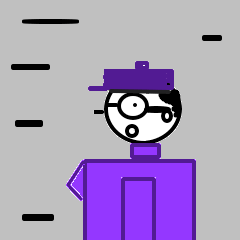
"He looked just like me, a slight young man in a peacoat and newsboy’s cap, with thick round glasses, and smoking a cigarette, but he was me without all my boring faults and personality traits. He was me if I were not a twerp."

"The better part of you, shall we say?"

"Yes. He was standing right before me. But right now he is only in my head."

The lady took a drag of her cigarette (the sort of drag the writers of the trashy novels Milford surreptitiously read called "a contemplative drag")


and then exhaled an enormous cloud of smoke which blended seamlessly into the greater cloud of smoke in which they sat.

"I hope you won't take this the wrong way," she then said, "but has it occurred to you that you may very well be in the midst of what the headshrinkers call a psychotic episode?"

"Well, okay, but here's the thing."

"Oh, there's a thing."

"Yes, you see, earlier this evening I foolishly ate a handful of these mushrooms –"

"Ah, the sacred mushrooms of the American Indians?"

"Yes."


"I see. And so then could it not be that this alter ego of yours, this – what was his name?"

"Stoney."

"Stoney."

"Yes, he said his name was Stoney."

"Could it not then be that this 'Stoney' is perhaps – perhaps I say – an hallucination brought on by the mushrooms?"

"Well, maybe."


"Maybe?"

"Yes, I say maybe because maybe he was always there, inside me, but it took the mushrooms for me to be able to see him, to hear him –"

"To converse with him."

"Yes," said Milford.

"And even to appear to you in person?"

"Well, uh, I know it's a little hard to believe, but –"


"And is he in there right now, in your head?"

"I believe so, yes."

"May I speak to him?"

Go ahead, Milford, said Stoney's voice in Milford's head. Let me talk to her.

"Well, maybe just briefly," said Milford.

"Hello," said Stoney, through Milford's voice.

"Is this Stoney speaking?" said the lady.


"Yes, it's me," said Stoney, in his strong and confident voice. "Very pleased to meet you. Margaret, isn't it?"

"Yes. Margaret Blackbourne. How are you, Stoney?"

"I'd be better if I wasn't trapped in the carcass of this idiot, I'll tell you that much."

"Well, at least you have a sense of humor about it," she said.

"Believe me, lady, being the alter ego of this guy, you have to have a sense of humor."


"Ha ha. This is weird. And I am used to weird, but I must say this is the first time I've ever spoken to someone's alter ego."

"Well, this is only about the second time I've ever spoken to another human being besides Milford, so it's weird for me, too."

"You don't sound too nonplussed about it."

"Look, Margaret, I take things as they come. Because this is the way to live, just striding manfully through life, living every second to the hilt and knocking out splendid poems when I'm in the mood, and then when I die, I can say, 'I have lived my life in full. Whatever happens now, be it nothingness or heaven or hell or reincarnation as a toad or a lion, bring it on, I have no regrets.'"


"What a delightful philosophy."

"I like to think so. Get it while you can, that's my motto. Full speed ahead and damn the torpedoes. And, please pardon my language, but, fuck 'em all if they can't take a joke."

"Brilliant. I wonder if I may speak to Milburn again now?"

"Milford? Sure. Nice speaking with you, Margaret."

"Likewise, Stoney."


"And, listen, Margaret, don't be too hard on Milford. I know he's a jerk, but he doesn't mean any harm."

"I will bear that in mind. Goodbye, Stoney."

"Not goodbye, but shall we say au revoir?"

"Yes, of course, au revoir, Stoney."

"Till we meet again," said Stoney.

The lady paused, smoking her black cigarette.

"Is he gone?"


"Yes," said Milford.

"Did you hear all that?"

"Yes."

"Good God."

"I know."

"This Stoney's rather full of himself, don't you think?"

"Yes, I suppose so."


"I hope you won't be offended if I say I prefer you to your drugs-induced subconscious alter ego."

"No." 

Boy, that hurts, said Stoney, in Milford's tortured brain. 

"Go away now, please," said Milford.

"What?" said the lady.

"I was speaking to him," said Milford. "To Stoney."


"Oh, good," she said. "But I shouldn't worry. He'll probably disappear for good once those mushrooms wear off."

"I hope so," said Milford. "It's bad enough having one personality, let alone two."

"You don't happen to have any more of those mushrooms on you, do you?"

"No, sorry."

"Quel dommage. As my good friend Charles Baudelaire put it, and I shall translate liberally, 'One must always get plastered. On wine, on poetry, on virtue, your choice.' To which I would add the sacred mushrooms of the noble red man. And woman. Drink up, Mordred."


Milford lifted his highball and drank, and sighed.

"Do you always sigh so much?"

"Yes," said Milford. "I wake up sighing, and go to sleep sighing, and in between I sigh, frequently."

"It could be worse," said the lady. "You could be one of these other losers in this joint. And at least you're young, for the moment. Once you hit thirty the downward slide begins."

"I feel that for me the downward slide began at birth."

"Ha ha. I almost regret that your corporeal being is so unimpressive."

"So do I, and there's no 'almost' to qualify my regret."


"Have you considered a course of physical self-improvement. The vigorous lifting of dumbbells, long swims in the ocean?"

"No, I generally detest any form of physical exertion, and the only reason I would jump into the ocean would be to attempt to drown myself. But there's no fear of my doing that, because as well as being a bad poet, and a lazy idle loafer, I am also a coward."

"Ha ha. You amuse me. I've met all kinds of lost poets in my time, and I admit I've even had carnal and sometimes even emotional relations with some several, but you, Malone, are the first time I've ever met a modest lost poet."


"I have nothing not to be modest about."

"Read some more of Theodore's poem."

"Okay."

Milford picked up the sheet of paper, found his place, and began to read aloud again.

And if you should kick me in my manly sac
and then strike me on the head with your purse,
I should not cry alas, nay, nor alack,
because to be ignored would be far worse.


Yes, I should fall to my knees, and worship,
even if you should grind your high heel (again)
into the back of my neck, its stiletto tip
causing me such sweet glorious pain.

Oh, Margaret, wilt thou not bless me
with a curse from your scarlet tongue
wilt thou not with disdain address me
as swine, as dog, as beetle dung? 

Milford laid down the sheet of paper.

"Can't take any more, Morton?" said the lady.


"I'll say this," said Milford. "It's nice to know there are possibly worse poets than myself."

"There are always worse poets, Muldoon," said the lady, dare he address her as Margaret?

"By the way," he said, "I know it doesn't really matter, but my name is actually Milford"

"Milford?"

"Yes."


"I beg your pardon. I thought it was Murgatroyd or something like that. Milborn, you say?"

"Milford."

"Milford."

"Yes."

"Very well, I shall call you Milford then."

Ask her if you can call her Margaret, said the voice in Milford's head.

"May I call you Margaret?" asked Milford.


She paused. 

"It may be too soon," she said.

"I understand," he said.

"I have always regretted allowing men even the slightest leeway."

"I don't blame you."

"You may call me Miss Blackbourne, at least for the nonce."

"Of course," said Milford.


"Better not to rush into intimacy."

"Okay."

"Okay what?"

"Okay, Miss Blackbourne?"

"That's better. And I shall call you, what was it, Mifford?"

"Milford."

"I shall call you Milford."


Baby steps, said the voice of Milford's alter ego Stoney, who was still there, lurking behind the scenes in his brain. You're taking baby steps for now. But maybe someday you will walk proudly, like a man.

Milford was on the verge of responding to this last remark of his alter ego's, but he remembered that Miss Blackbourne was sitting right there across the table from him, from him and from Stoney both, and so he held his peace.


Wednesday, May 29, 2024

"A Fantastical Supposition"


Another tale of la vie de la bohème, by Dan Leo

Illustrations and additional dialogue by rhoda penmarq, exclusively for quinnmartinmarq™ productions

This episode made possible in part through the generous support of the Husky Boy™ Tobacco Company Foundation for the Furtherance of the Arts

"Smooth, yet strong, rich, yet soothing – Husky Boy cigarettes are the 'secret fuel' for all my creative endeavors!" – Horace P. Sternwall, author of Musings of a Merry Misanthrope

for previous story, click here

to begin series, click here


"Perhaps you are wondering why I dragged you away from the bar," said the woman in black named Margaret.

"Yes, the question had passed through the private mental ward I call my brain," said Milford.

"I'll tell you why," she said. "If you want me to."

Would she say it was because she found him sexually attractive? As fantastical as that supposition might be? But, no…


"I will take your silence as an affirmative," she said. "And the reason I dragged you by main force away from the bar and to this table was simply that I just couldn't bear to see that ghoul Ezekiel drooling all over you. Let him find some other catamite."

"But I'm not a catamite."

"Are you quite sure of that?"

"I am quite sure of nothing."

"Let me reformulate the question. Have you ever had sexual relations with a male human being."


"No," said Milford. "But –"

"But what?"

"But I've never had sexual relations with a female human being either."

"Please don't be offended if I say I'm not surprised."

"I won't be."

"Take comfort if you will in the thought that sexual relations are invariably unpleasant."

"I will try to do that." 


Milford saw his beer glass there, and, forgetting that "he didn't drink", he picked up the glass and drank.

Sighing, for the twelve-thousandth-and-twenty-fourth time since he had unwillingly emerged from sleep long ago the previous morning, he set the glass back down, as another sad song played on the jukebox.

"Masturbation, however," said the lady, "is another matter entirely. How enjoyable to suffer as many orgasms as one can manage, and not have to share one's bed with some malodorous oaf, and to listen to his drivelings, before, during, and especially after. Not to mention his labored post-coital snoring."


"Uh," was Milford's only vocalized response.

Suddenly the waitress appeared again out of the fog of tobacco smoke, carrying her tray with two highball glasses on it.

"Oh, thank you, Ruthie," said Margaret, Margaret Blackthorne was it? "Please start a tab for me. We may be here for some time."

"Thumper said the round is on the house," said the waitress, putting down the drinks. "He said the next six rounds will also be on the house, on account of you have to put up with so much shit from all the male and lesbian and even hermaphroditic lost poets in this place, on account of you are the only truly beautiful woman in here."


"Yes, we all have our crosses to bear," said Miss whatever her name was. "Tell Thumper I thank him, and that I should like to buy you and him the shots of your choice."

"You ain't got to buy us shots, Margaret. We drink shots all the time, just to ease the horror of working here. It's like one of the perquisites of the job, even a necessity you might say." The waitress turned her gaze on Milford. She was a very short, round-faced woman with orange hair, but Milford knew that if it came to it she could beat him easily in a fight. "You better be nice to her, buddy. You don't know what an honor it is to have Miss Blackbourne invite you to sit with her at a table."


"I intend to be nice," said Milford, thinking, Blackbourne, I must remember that –

"Oh, wait a minute," said the waitress, "are you a poofter?"

"A what?"

"Are you a member of the American homosexual community?"

"Not that I know of."

"'Cause you look kind of queer."


"No, I'm only a bad poet."

"You finished with that beer by the way?"

"Oh," said Milford, and he raised his beer glass, swallowed what was left in it, and handed the glass to the waitress, who put it on her tray.

"I'll be back in five minutes or so to see if you guys need a refill," she said.

"Thank you, Ruthie," said Miss Blackbourne, not Blackthorne, and the waitress disappeared into the smoke and the babble again.


"Read the poem," said Miss Blackbourne.

"What?" said Milford.

"Theodore's poem. Read it aloud. I could use a laugh."

Milford looked at the sheet of paper on the table.

"I'm not a very good reader," said Milford. "I've been told I recite in one of those awful sing-song 'poet's voices' that poets read with."


"I would expect nothing less, and all the better. Now read."

Milford took a sip of the drink the waitress had put in front of him. It tasted like a highball, scotch and soda, not his favorite drink, but then he shouldn't be drinking at all. How many times had he already "slipped" this endless evening and night? Was it a half-dozen times? At this rate he would have enough material for a full year of AA meetings.

He cleared his throat, took a drag of his Husky Boy, lifted the sheet of paper closer to his nearsighted eyes, and began to read, aloud.


For Margaret: a Paean of Praise

They call her the Black Widow, the black widow spider
but all I desire is to sit down beside her,
to drink in her beauty, like rich red wine,
and then, having drunk it, to feel so very fine.

And were she to touch me, her flesh upon my flesh,
it would be all I could do not to get a trifle fresh,
and if she then slapped me, as I'm sure she would,
the sting would surely cause a stirring in my manhood.

Oh, Margaret, dear Margaret, goddess of gloom, 
won't you take me up into your room,
my heart beating like that of a spastic,
where we can trip the light fantastic?

Milford paused his reading, and looked at the lady, smoking her black-and-silver cigarette.


"Do you want me to continue?" he asked.

"Yes," she said, "pray continue."

Milford took a deep breath of the smoky air, and continued.

Yes, and will you allow me to enter your fleshly pocket,
to thrust and burrow deeply like a rocket
into the vast dark reaches of inner space,
or shall I be relegated to celibate disgrace?

Dear Margaret, please allow me just one chance
to stand before you with lowered pants
my trembling grasping hands outstretched,
and all my wretched soul upon you retched.

Milford put the sheet of paper down, picked up his highball and took another drink.

"Why did you stop?" said Margaret.


"I just needed a little break. There's a lot more as you can see. His handwriting is very small, and he's filled up both sides of this sheet of paper."

"Please feel free to take a rest."

"Thank you."

"And now do you see why I'm not crazy about sexual relations?"

Milford sighed again. Was this sigh the twelve-thousandth-and-twenty-fifth sigh of this long day and night's journey into endless night, pace Eugene O'Neill?


"Yes," he said, "if this poem is any indication, I can understand your, uh, disaffection."

"If you were a woman you would understand even better."

A voice spoke in Milford's brain, a familiar voice he hadn't heard in a half hour or so.

Well, I guess you better not get your hopes up, Milford, said the voice, the voice of his alter ego, named Stoney.

"Don't worry, my hopes are far from up," said Milford.


"What?" said Miss Blackbourne.

"Oh, I'm sorry," said Milford. "I wasn't addressing you."

"And whom, may I ask, were you addressing?"

"A voice in my head," he said. "Myself. Part of myself. No one."

She took a good drag of her black cigarette, and then stubbed it out in the ashtray that was there.


"I'm starting to find you strangely attractive, Murphy," she said.

Yes, said the voice in Milford's head, yes! Maybe there's still a chance after all?

"I'm not so sure of that," said Milford, aloud. 

Miss Blackbourne said nothing, as yet another sad song of lost love played on the jukebox.


Wednesday, May 22, 2024

"A Paean of Praise"


Another tale of the poet's life by Dan Leo

Illustrations and additional dialogue by rhoda penmarq, exclusively for quinnmartinmarq™ productions

This episode is brought to you by Husky Boy™ cigarettes, now available in the ten-carton Econo-Smoke™ box

"Hey, you only go through this crazy carnival called life once, so you might as well fire up a soothing but strongly flavorful Husky Boy!" – Horace P. Sternwall, author of the new "Father Mike" mystery Murder at the May Procession 

for previous story, click here

to begin series, click here


She gazed, smoking, out at the smoky barroom and Milford realized that in the preceding confusion he had left his own most recent cigarette burning in the ashtray at the bar, and that it was therefore incumbent upon him now to light up another. It was true, this situation was awkward, and there was nothing to be done in any awkward situation but to light up a cigarette. He dug out his pack of Husky Boys and his Ronson, and soon enough, after clicking the lighter no more than six times, he had a cigarette ignited and in his lips, and as he appreciated the hot rasping feeling in his weak and ravaged lungs it occurred to him that every single and general situation in his life had been awkward, up to and including this present moment.


No wonder he had so many nightmares, because science had not yet devised a way to allow human beings to smoke while they slept.

The woman named Margaret Blackbourne now steered her gaze toward Milford.

"I like it that you know how to remain silent. It's a rare quality in any man, the ability to keep his thoughts to himself, rarer still amongst poets, and all but nonexistent among so-called lost poets. Of which cohort I assume you are one."


"It's true I am lost," said Milford, after a minute's pause, while another sad song sung by a sad woman played on the jukebox and the ghostlike figures in the bar babbled. "But as for being a poet, I realized today that I have only written bad poetry."

"So you are a lost bad poet."

"Yes," said Milford, after a shorter pause. "I would say that is an accurate description."

A man emerged from the smoke and stood at their table.


He wore a long dark cloak-like coat, and a Greek fisherman's cap. His skin was pale grey, his cheeks hollow, as were his eyes, on either side of a nose that was long and sharp. His face was stubbled with dark whiskers, and he held a brown cigarette.

"Why do you torture me, Margaret," the man said.

"Why do you torture me, Theodore?"

"I torture you only because you torture me."

"Exactly the same reason why I torture you," she said. "Oh, by the way, Milvern is it?"

"Milford actually," said Milford.

"Milford," she said, "meet Theodore. A fellow lost poet."

"I prefer the term poète maudit," said the man.

"No one cares what you prefer, Theodore," said Margaret.

"Hello," said the man to Milford.

"Hello," said Milford. He stood up awkwardly and awkwardly extended his hand, but then realized he was holding his cigarette in that hand.

He quickly shifted the cigarette to his left or non-shaking hand, and re-offered his right hand.

"I will accept your handshake," said the man, "but only grudgingly and because I don't want to make a scene." 

They shook hands, and, thank God (in whom I fervently and now more than ever do not believe, thought Milford), the man's handshake was weak, even weaker than Milford's, which was certainly weak, from a lifetime of taking no exercise more vigorous than the lighting of cigarettes.


"Pleased to meet you," said Milford, withdrawing his hand with a slight slithering sound.

"I wish I could say the same," said the man. "I hope you know that Margaret will destroy your manhood."

"Well, we've only just met," said Milford. "But–"

He paused.

"But what?" said the man called Theodore.

"But I'm not so sure I have a manhood to destroy," said Milford.

Now the man paused, as Milford stood there, awkwardly.

"Damn you," said the man, finally. "Damn you and all your kind."

"If you're wishing me to be damned to hell," said Milford, not knowing what he was going to say, "that may well happen, if there is a hell, and if if men are to be damned to it for being lazy talentless layabouts."


"Damn your eyes," said the man. "If I were not a coward I should slap you, not just once but twice, one with open hand and one back handed."

"It's always good to meet a fellow coward," said Milford.

"Yes, that's true," said the man. "Perhaps not good, but not bad." He turned to Margaret. "I'm almost starting to like this fellow, Margaret."

"What?" she said.


"I said I'm almost starting to like your new paramour."

"Who gives a damn who you like or don't like, Theodore?"

"It should be 'whom' I like or don't like."

"Oh, fuck off."

"I beg your pardon."

"I said fuck off."

"Do you mean that in the physical sense, or the metaphorical?"


"I mean it in every possible sense."

"You're saying you want me to quit your presence."

"Yes."

"Very well. If you want me to leave, I shall."

"Good."

"Don't beat about the bush, just say it."

"Fuck off."

"Just say it and I'll never trouble you with my presence again."


"Okay," said Margaret. She took a drag of her cigarette, exhaled a great cloud of smoke, and then repeated, "Fuck off."

"Oh," said the man. "And you really mean that?"

"Yes," she said.

"Okay, fine, I'll leave then, gladly." he said. "But first, here."

He reached into the depths of his cloakish coat and came out with a folded-up sheet of paper. He unfolded it and proffered it to Margaret. She ignored it.


"It's a poem," he said.

"Why am I not surprised?" she said.

"Do you want me to read it to you?"

"No," she said.

"Okay," he said. "I'll just leave it on the table here." 

He placed the sheet of paper on the table.

"You can read it whenever you get a chance, a spare moment."


She said nothing.

Milford was still standing there, awkwardly.

"You can read it too, Millibrand," said the man. "You seem like a sensitive guy."

"Oh, okay," said Milford. "Thanks."

"You're welcome," said the man. "But please bear in mind that I just wrote it not five minutes ago, so it might still be a bit raw. I might need to do a few small revisions."

"Okay," said Milford.


"I am a great believer in the first bold flush of inspiration, and yet even the most brilliant effusions sometimes need a bit of rewriting, a slight touch of polish. Don't you agree?"

"Yes, I suppose that's so. But then also I suspect that no amount of rewriting or polishing can save something that was essentially rubbish from the start."

"An interesting thesis, but I am not sure I agree."

"I'm not sure I agree either," said Milford.


"Nonetheless, I'd actually be interested in hearing your thoughts."

"My thoughts?"

"Yes."

"About –"

"About my poem."

"Oh, right, sure."

"What did you say your name was again. Melliford? That's an odd name for a first name."


"I, uh," said Milford.

"Theodore," said Margaret.

"Yes?" said Theodore.

"Fuck off," she said.

A waitress came over, carrying a round bar-tray under her arm. At least Milford assumed she was a waitress, as she wore a black apron over her pale grey smock.

"Do you want me to find you a chair?" she said to Theodore.


"No, Ruthie," said Margaret. "He's not staying."

"I wouldn't mind sitting for a bit," said Theodore. "We could read my poem, and then discuss it."

"I would rather punch myself in the face," said Margaret. "Repeatedly."

"We don't have to read the poem right now."

"Don't make me put this cigarette out in your hand, Theodore," said Margaret.


"I wish you would," said Theodore. "I should wear the scar like a badge of honor."

"I wish I had a drink so I could throw it in your face," said Margaret.

"Speaking of which," said the waitress, "can I get you a drink, Margaret?"

"Sure, Ruth," said Margaret, "tell Thumper I'll take my usual, and better bring my friend Milburn here another glass of beer."

"Oh, that's okay," said Milford, "I don't want another beer."


"Bring him what I'm drinking then," said Margaret.

"I would like an absinthe," said Theodore.

"I'm sure you would," said Margaret, "but you're not drinking it at this table."

"So you would really like me to go."

"Yes," said Margaret.

"You know, I wrote that poem for you."

"I have no doubt."


"Poured out my heart and soul."

"Milbert," said Margaret.

"Me?" said Milford.

"Yes, whatever your name is, if this fellow doesn't leave at once I want you to punch him. I would do it myself, but I like to think I am a lady."

"But," said Milford.

"But what?"

"I have never punched anyone in my life."


"Then it's high time you learned how. Give him a good hard right to the breadbasket, that way you're less likely to hurt your hand."

"All right, all right, there is no need for violence, I'm going," said Theodore. "Ruthie, would you please bring me another absinthe to my table, with another small carafe of water? Oh, and I may need some more sugar cubes."

"Sure, Teddy," said the waitress, and she walked away.

"Well, okay, I'm going then," said Theodore.


"Goodbye," said Margaret. "And good riddance."

Theodore addressed Milford again.

"Let me know what you think of the poem. I'll be sitting across the room there with some other chaps, they're all poètes maudits as well."

"Uh," said Milford.

At last the man went away, into the smoke.

"You can sit down now," said Margaret.

"Oh, right," said Milford, and he took his seat again. 

The sheet of paper was lying right there. It was covered in scrawled ink. Idly Milford turned the paper with his fingers so that the writing was facing him. Centered at the top of the page were written the words

For Margaret: a Paean of Praise